Turbine joins Multimodal AI-ready data collaboration to train Virtual Assays in immune biology
Read more

Publications

Virtual Screening of Subtype-Matched NSCLC Cell Lines Uncovers Known and Novel Therapeutic Dependencies 
Poster

Hasan Mamar, Imre Gáspár, Peter Szikora, Szabolcs Tarapcsák, Bálint Pfliegel, Valér Kaszás, John Michael Krill-Burger, Brent Paolella, Andrey Loboda, Vinay Varadan, István Taisz, Dániel Veres

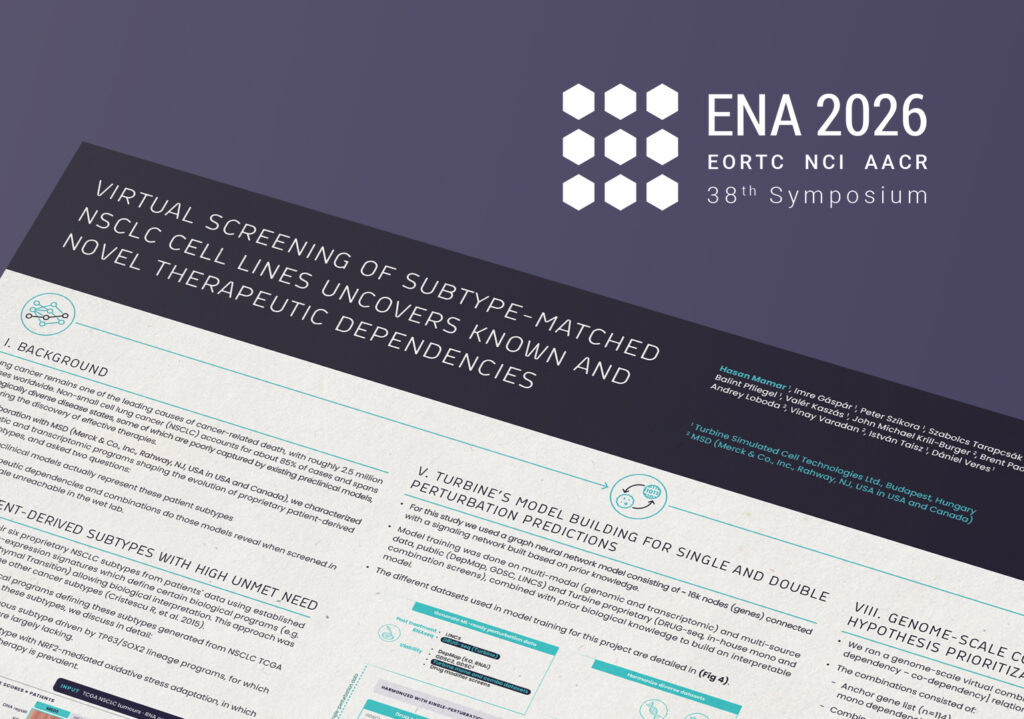
Together with MSD, we mapped NSCLC cell lines to patient-derived subtypes and ran a genome-scale virtual combination screen. One model recovered 73% of held-out DepMap subtype dependencies and narrowed 230 million gene pairs to 5 to 10 testable combination hypotheses. read more

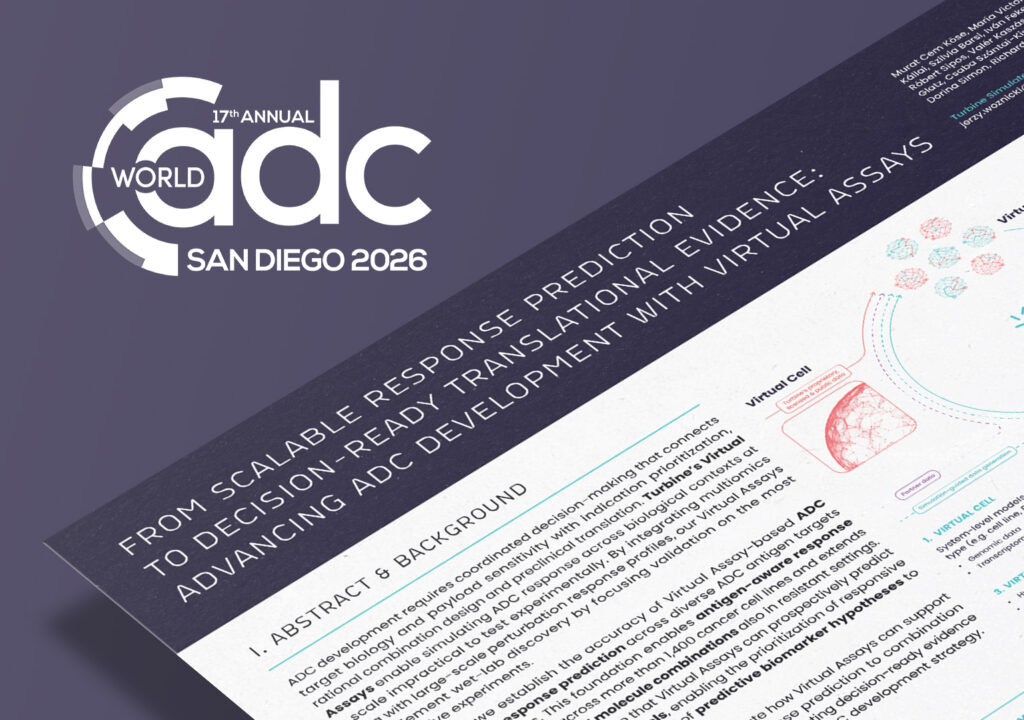
From Scalable Response Prediction To Decision-Ready Translational Evidence: Advancing ADC Development With Virtual Assays 
Poster

Murat Cem Köse, María Victoria Ruiz Pérez, Imre Gáspár, Dóra Kállai, Szilvia Barsi, Iván Fekete, Matteo Tardelli, Dana Zemel, Róbert Sipos, Valér Kaszás, Bálint Pfliegel, Lucie Studená, Gábor Glatz, Csaba Szántai-Kis, Rawan Abukhairan, Krisztina Jakab, Dorina Simon, Richard Izrael, Jerzy Woźnicki, Dániel Veres

ADC development requires coordinated decision-making that connects target biology and payload sensitivity with indication prioritization, rational combination design and preclinical translation. Turbine’s Virtual Assays enable simulating ADC response across biological contexts at a scale impractical to test experimentally. By integrating multiomics data with large-scale perturbation response profiles, our Virtual Assays complement wet-lab… read more

Correcting Cell Count Bias Improves Perturbation Effect Estimates and Virtual Cell Models 
PosterTRAIL

Gerold Csendes, Bence Czakó, Gema Sanz, Zsolt Gyüre, Milán Sztilkovics, László Mérő, Gábor Kovács, Kristóf Szalay, Bence Szalai

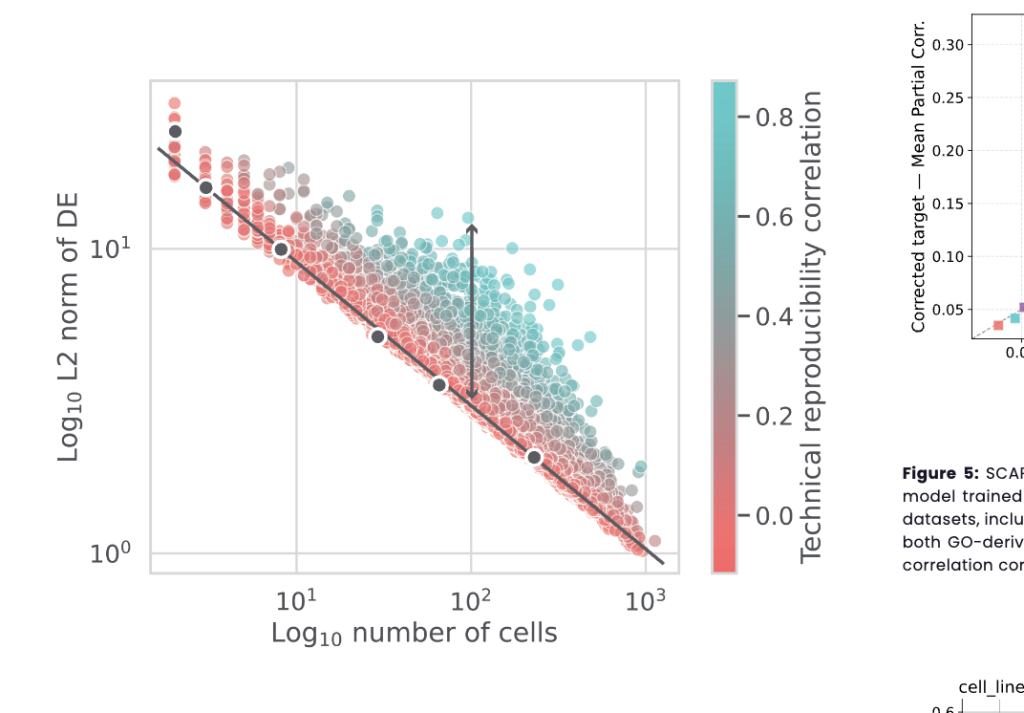
Target identification and combination screening uncover context-specific therapeutic vulnerabilities, characterize molecular determinants of target dependency, and identify rational combination strategies. While large-scale perturbation studies can be performed experimentally, systematically profiling diverse tumor models, molecular subtypes, and therapeutic contexts remains resource-intensive and limits exploration across broader biological landscapes. To address this challenge, we… read more

Virtual Target Identification and Double Perturbation Screens Enable Scalable Discovery of Pancreatic Cancer Vulnerabilities and KRAS Combination Opportunities 
PosterTRAIL

Hasan Mamar, Csilla Hegedüs, Iván Fekete, Imre Gáspár, László Mérő, István Taisz, Valér Kaszás,Szabolcs Tarapcsák, Kata Szégner, Zsolt Gyüre, Milán Sztilkovics, Kristóf Szalay, Dániel Veres, Krishna Bulusu

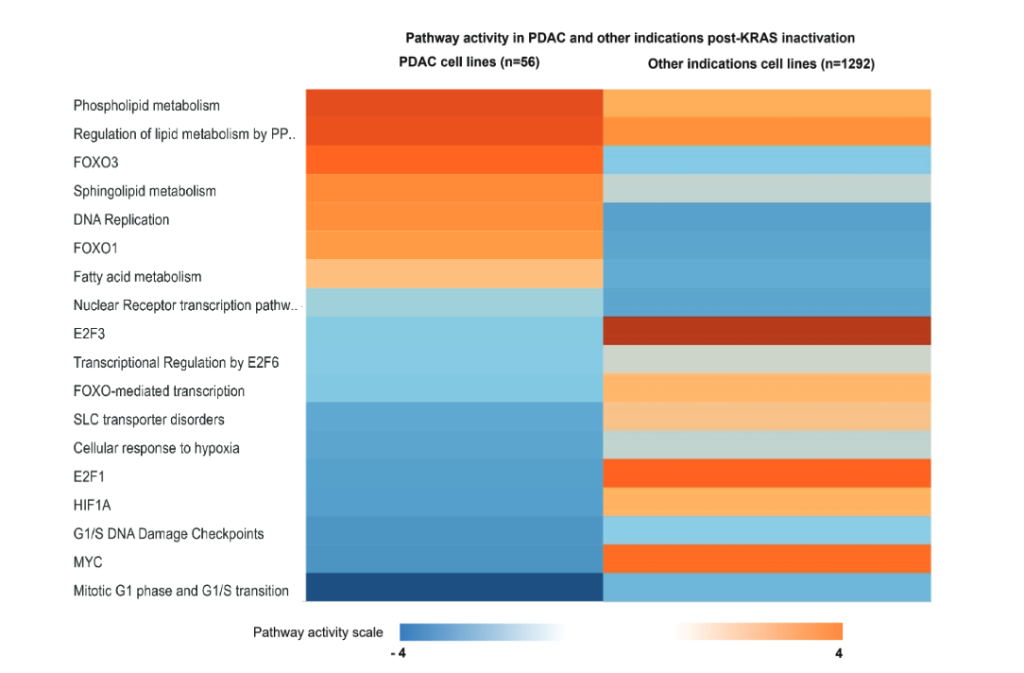
Target identification and combination screening uncover context-specific therapeutic vulnerabilities, characterize molecular determinants of target dependency, and identify rational combination strategies. While large-scale perturbation studies can be performed experimentally, systematically profiling diverse tumor models, molecular subtypes, and therapeutic contexts remains resource-intensive and limits exploration across broader biological landscapes. To address this challenge, we… read more

Computational and Experimental Analyses Identify Indicators of Response to the CDC7 Inhibitor CRT2199 Beyond General Drug Sensitivity 
Poster

Hasan Mamar, Dora Kallai, Peter Szikora, Ivan Fekete, Arpad Varga, Csilla Laczka, Nora Ordasi, Elisabeth Trivier, Daniel V. Veres

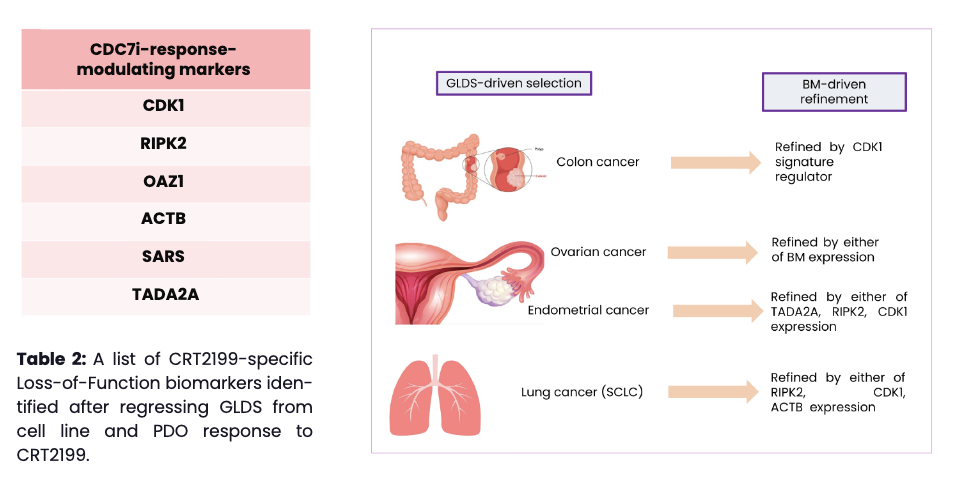
Cell Division Cycle 7 (CDC7) is a serine/threonine kinase that plays a critical role in the initiation of DNA replication. In complex with its regulatory subunit DBF4, CDC7 phosphorylates components of the MCM2–7 helicase, enabling replication origin firing and S-phase entry. Tight regulation of CDC7 activity is essential for genome stability, as… read more