Turbine and Daiichi Sankyo Expand ADC Discovery Collaboration
Read more

Publications

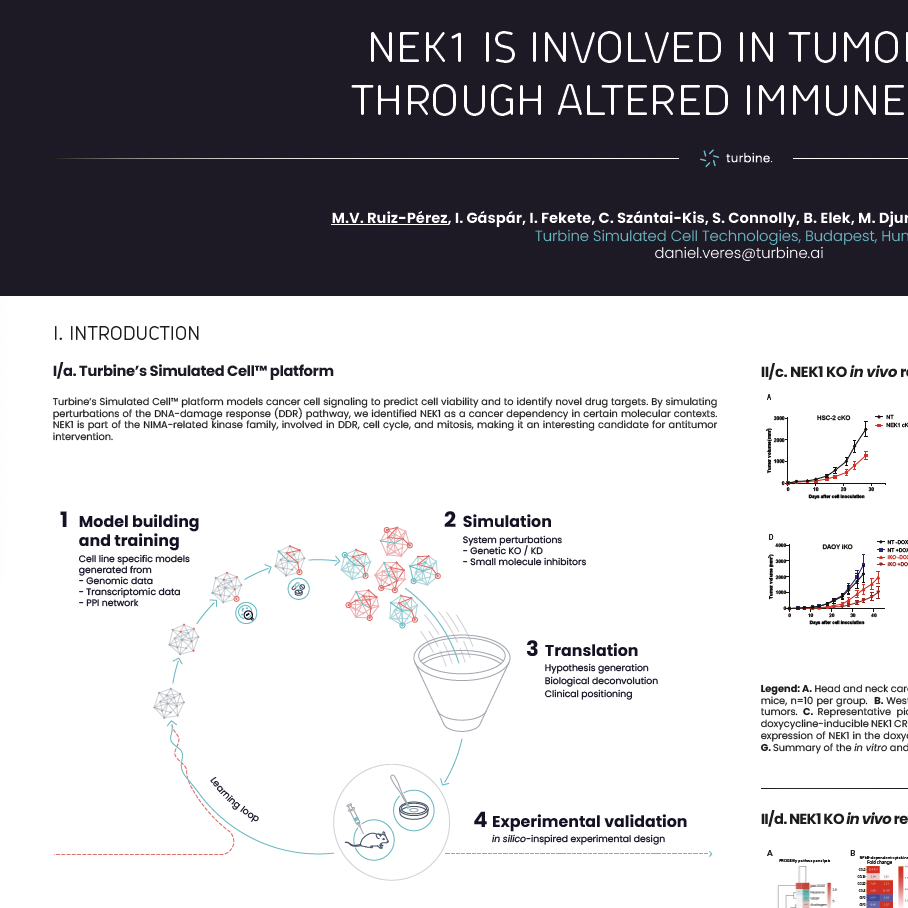
NEK1 is involved in tumor growth through altered immune signaling 
Poster

M.V. Ruiz-Pérez, I. Gáspár, I. Fekete, C. Szántai-Kis, S. Connolly, B. Elek, M. Djurec, C. Hegedüs, I. Taisz, D. Veres

Turbine’s Simulated Cell™ platform models cancer cell signaling to predict cell viability and to identify novel drug targets. By simulating perturbations of the DNA-damage response (DDR) pathway, we identified NEK1 as a cancer dependency in certain molecular contexts. NEK1 is part of the NIMA-related kinase family, involved in DDR, cell cycle, and… read more
The EFFECT benchmark suite: measuring cancer sensitivity prediction performance – without the bias 
Preprint

Bence Szalai, Imre Gaspar, Valer Kaszas, Laszlo Mero, Milan Sztilkovics, Kristof Z. Szalay

Creating computational biology models applicable to industry is much more difficult than it appears. There is a major gap between a model that looks good on paper and a model that performs well in the drug discovery process. We are trying to shrink this gap by introducing the Evaluation Framework For predicting… read more

The EFFECT Benchmark Suite: Measuring cancer sensitivity prediction performance – without bias 
PosterTRAIL

Bence Szalai, Imre Gáspár, Valér Kaszás, László Mérő, Milán Sztilkovics, Kristóf Z. Szalay

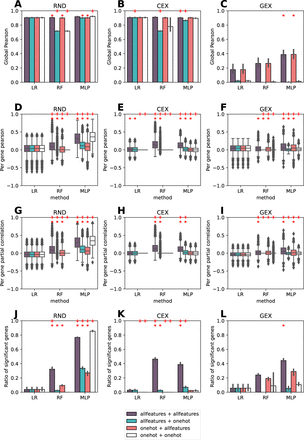
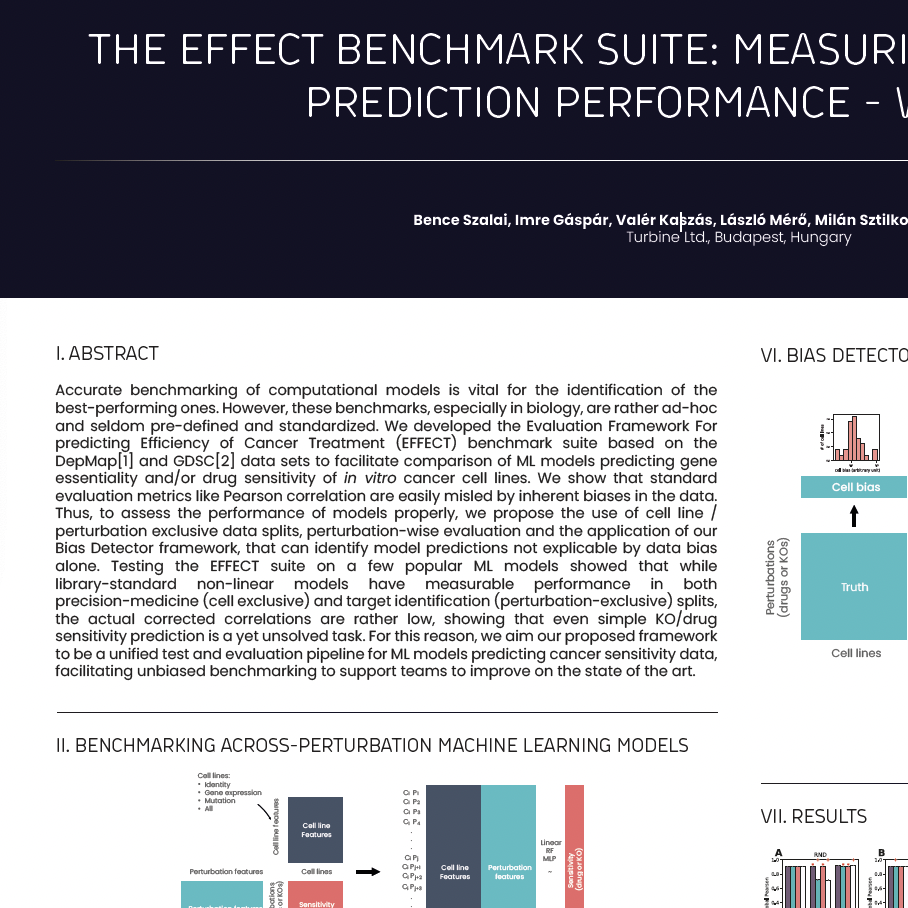
Accurate benchmarking of computational models is vital for the identification of the best-performing ones. However, these benchmarks, especially in biology, are rather ad-hoc and seldom pre-defined and standardized. We developed the Evaluation Framework For predicting Efficiency of Cancer Treatment (EFFECT) benchmark suite based on the DepMap and GDSC data sets to facilitate… read more

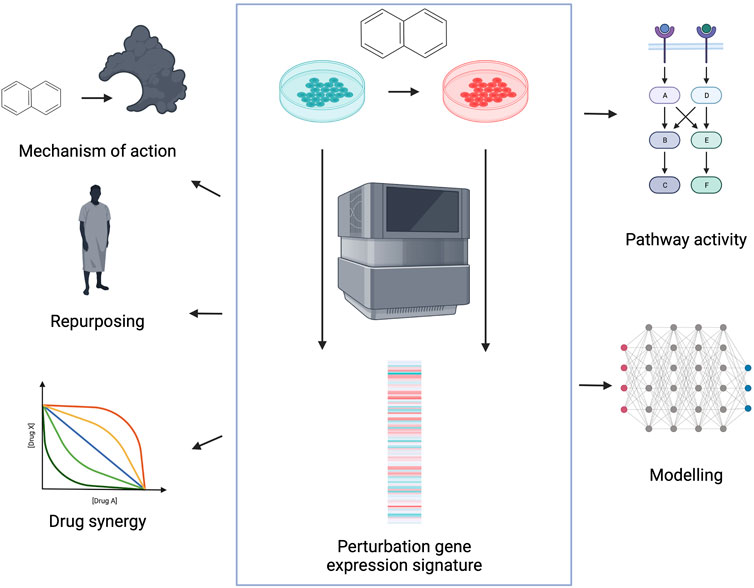
Application of perturbation gene expression profiles in drug discovery – From mechanism of action to quantitative modelling 
Publication

Bence Szalai, Daniel V. Veres

High dimensional characterization of drug targets, compound effects and disease phenotypes are crucial for increased efficiency of drug discovery. High-throughput gene expression measurements are one of the most frequently used data acquisition methods for such a systems level analysis of biological phenotypes. RNA sequencing allows genome wide quantification of transcript abundances, recently… read more

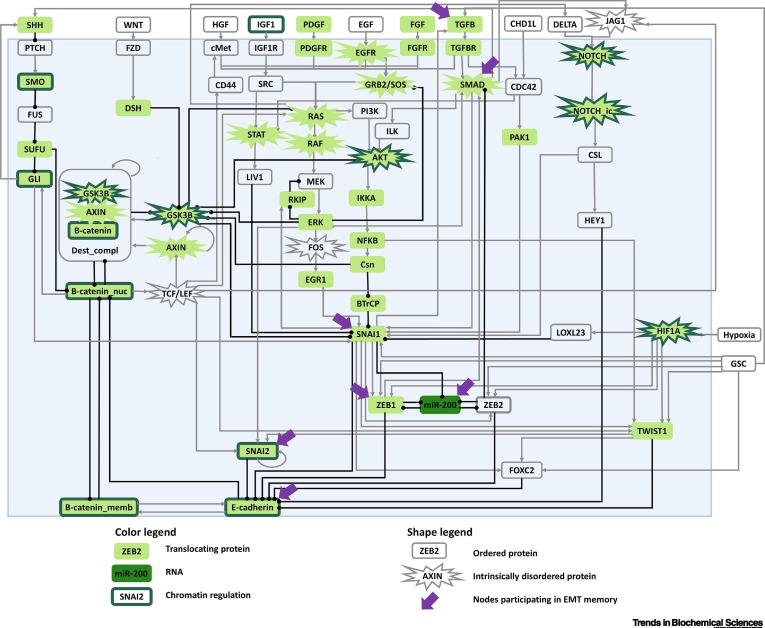
Learning of Signaling Networks: Molecular Mechanisms 
Publication

Peter Csermely, Nina Kunsic, Peter Mendik, Mark Kerestely, Teodora Farago, Daniel V. Veres, Peter Tompa

Molecular processes of neuronal learning have been well described. However, learning mechanisms of non-neuronal cells are not yet fully understood at the molecular level. Here, we discuss molecular mechanisms of cellular learning, including conformational memory of intrinsically disordered proteins (IDPs) and prions, signaling cascades, protein translocation, RNAs [miRNA and long noncoding RNA… read more

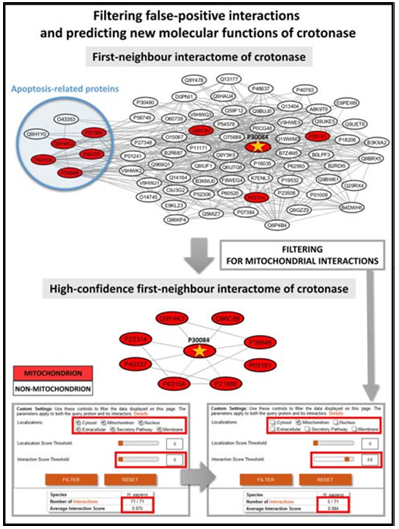
ComPPI: a cellular compartment-specific database for protein–protein interaction network analysis 
Preprint

Daniel V. Veres, David M. Gyurko, Benedek Thaler, Kristof Z. Szalay, David Fazekas, Tamas Korcsmaros, Peter Csermely

Here we present ComPPI, a cellular compartment-specific database of proteins and their interactions enabling an extensive, compartmentalized protein–protein interaction network analysis (URL: http://ComPPI.LinkGroup.hu). ComPPI enables the user to filter biologically unlikely interactions, where the two interacting proteins have no common subcellular localizations and to predict novel properties, such as compartment-specific biological functions. read more